
Understanding SCADA Architecture in Modern Industrial Automation
Contents
Supervisory Control and Data Acquisition (SCADA) systems form the nerve centre of modern industrial operations. Whether in a water treatment plant, a power distribution grid, or a manufacturing facility, SCADA integrates hardware and software to monitor process variables, display operator interfaces, and log critical data.
To design or troubleshoot a SCADA network, you must understand how data moves from physical instruments on the factory floor to supervisory software applications.
The Four Layers of a SCADA System Architecture
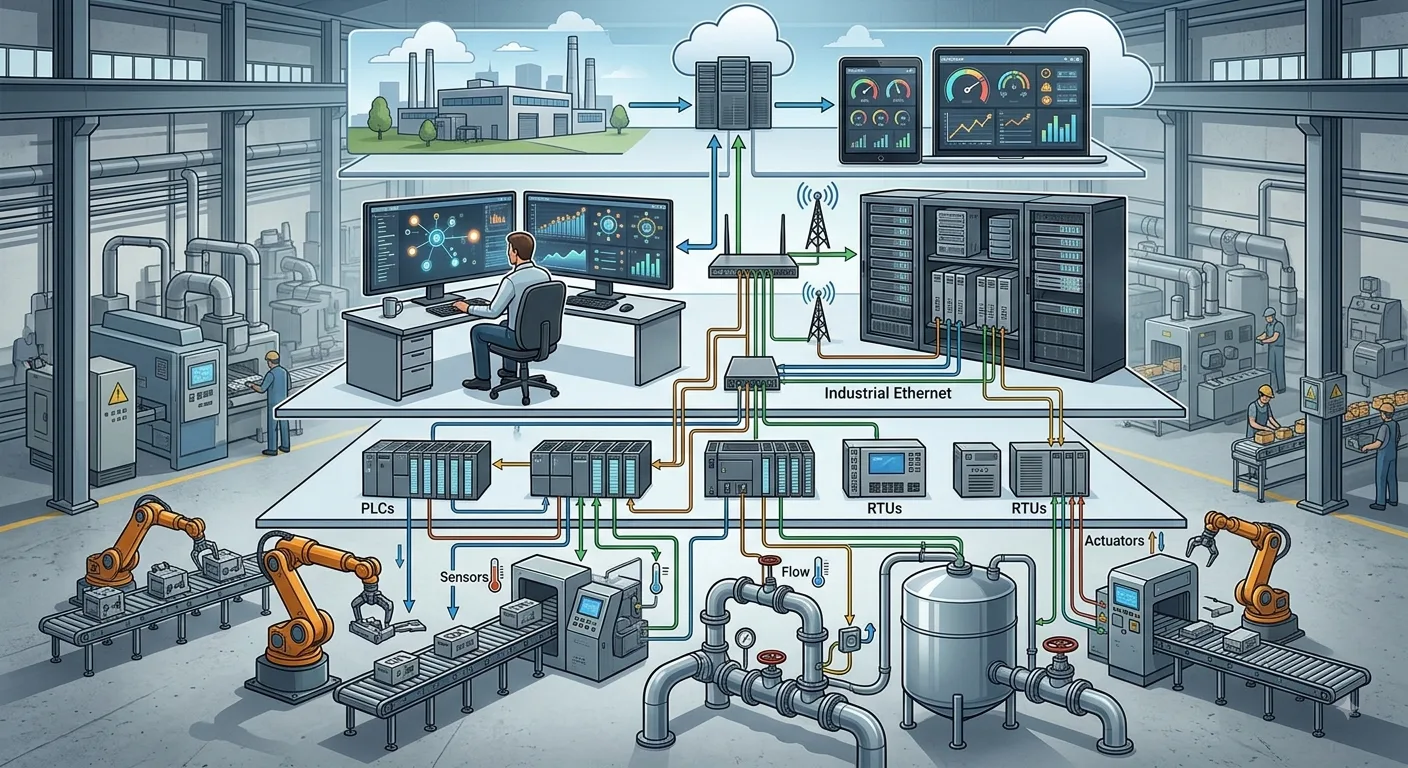
SCADA systems operate across a defined hierarchy, often referenced against the Purdue Enterprise Reference Architecture.
- Field Instrumentation (Level 0): Sensors, transmitters, valves, and motors that interact directly with the physical process. Examples include pressure transmitters, thermocouple probes, and variable frequency drives.
- Direct Control (Level 1): Programmable Logic Controllers (PLCs) and Remote Terminal Units (RTUs). These devices execute fast, deterministic logic loops locally, reading field inputs and driving field outputs independently of the supervisory server.
- Supervisory Control (Level 2): SCADA servers and operator Human-Machine Interfaces (HMIs). The server polls Level 1 controllers for status updates, processes alarm conditions, and serves graphics to operator displays.
- Operations and Enterprise (Levels 3 and 4): Manufacturing Execution Systems (MES) and Enterprise Resource Planning (ERP) databases. These systems extract historical data from the SCADA layer for production scheduling, asset management, and reporting.
Understanding this separation is essential. A common error among junior engineers is assuming the SCADA server executes primary safety interlocks. Primary safety and immediate control loops must always reside in the PLC, ensuring the plant remains safe even if the SCADA server or network fails.
Communication Protocols and Data Flow
SCADA servers retrieve operational data using structured industrial communication protocols. Historically, field buses like Modbus RTU and Profibus DP dominated factory floors. Modern installations rely heavily on Ethernet-based standards.
- Modbus TCP: A simple, unencrypted protocol widely used for reading registers in field devices over standard Ethernet networks.
- OPC UA (Open Platform Communications Unified Architecture): A platform-independent, secure protocol designed for industrial automation. It provides encrypted transport, rich data modelling, and seamless communication between hardware from different vendors.
- DNP3 and IEC 60870-5-104: Protocols engineered for geographically distributed networks, such as electric utilities and pipelines. They feature native timestamping and buffer data at the RTU level during network outages.
Data acquisition occurs through two main methods: periodic polling and report-by-exception. Periodic polling requests data from PLCs at fixed time intervals (for example, every 500 milliseconds). Report-by-exception requires the controller to transmit data only when a value changes beyond a set deadband threshold, significantly reducing network bandwidth consumption.
Alarm Management and Process Visualization
An effective SCADA HMI presents critical information without overwhelming the operator. Traditional HMI design relied on bright colours, 3D pipe renderings, and flashing animations. Modern standards, such as ISA-101 (High-Performance HMI), emphasize minimal visual clutter.
In a High-Performance HMI design, background screens use neutral grey tones. Process elements remain monochromatic during normal operation. Bright colours are reserved exclusively for abnormal conditions and active alarms, drawing immediate operator attention to anomalies.
Alarm management must follow established engineering standards like ISA-18.2. Poorly configured systems create 'alarm flooding', where a single equipment trip triggers hundreds of secondary alarms, obscuring the root cause. Proper SCADA engineering involves setting rationalised alarm limits, priorities (low, medium, high, emergency), and deadbands to eliminate nuisance alarms.
Common Implementation Mistakes to Avoid
Engineers frequently encounter operational issues due to foundational flaws in SCADA system design:
- Direct Internet Exposure: Exposing SCADA servers or PLCs directly to public IP addresses without a Virtual Private Network (VPN) or industrial firewall creates severe cybersecurity vulnerabilities.
- Unsegmented Networks: Combining IT corporate network traffic with OT (Operational Technology) industrial traffic causes packet jitter and network congestion, leading to dropped telemetry polling cycles.
- Hardcoding Addresses: Assigning fixed IP addresses inside script logic rather than using structured tag name syntax makes network maintenance and device replacement unnecessarily difficult.
- Ignoring Database Growth: Failing to configure automated database pruning or compression routines on the SCADA historian server results in disk space exhaustion over extended running periods.
Developing Skills in SCADA Engineering
To build competence in SCADA design, start by mastering core PLC fundamentals, such as memory mapping, register structures, and digital/analogue signal scaling. Understanding how data is stored inside a PLC tag makes configuring SCADA tag databases straightforward.
Next, focus on networking fundamentals: IP subnets, VLANs, routing, and industrial switch configuration. Practice connecting demo SCADA packages to software-based PLC emulators using OPC UA servers.
At NEXISTEK, our technical training programmes cover the full spectrum of industrial automation. Learners gain practical instruction in PLC programming, HMI screen design, industrial protocol configuration, and SCADA architecture setup to prepare for real-world engineering challenges.