
What Is PLC and SCADA? A Beginner’s Guide for Engineering & Diploma Students
Contents
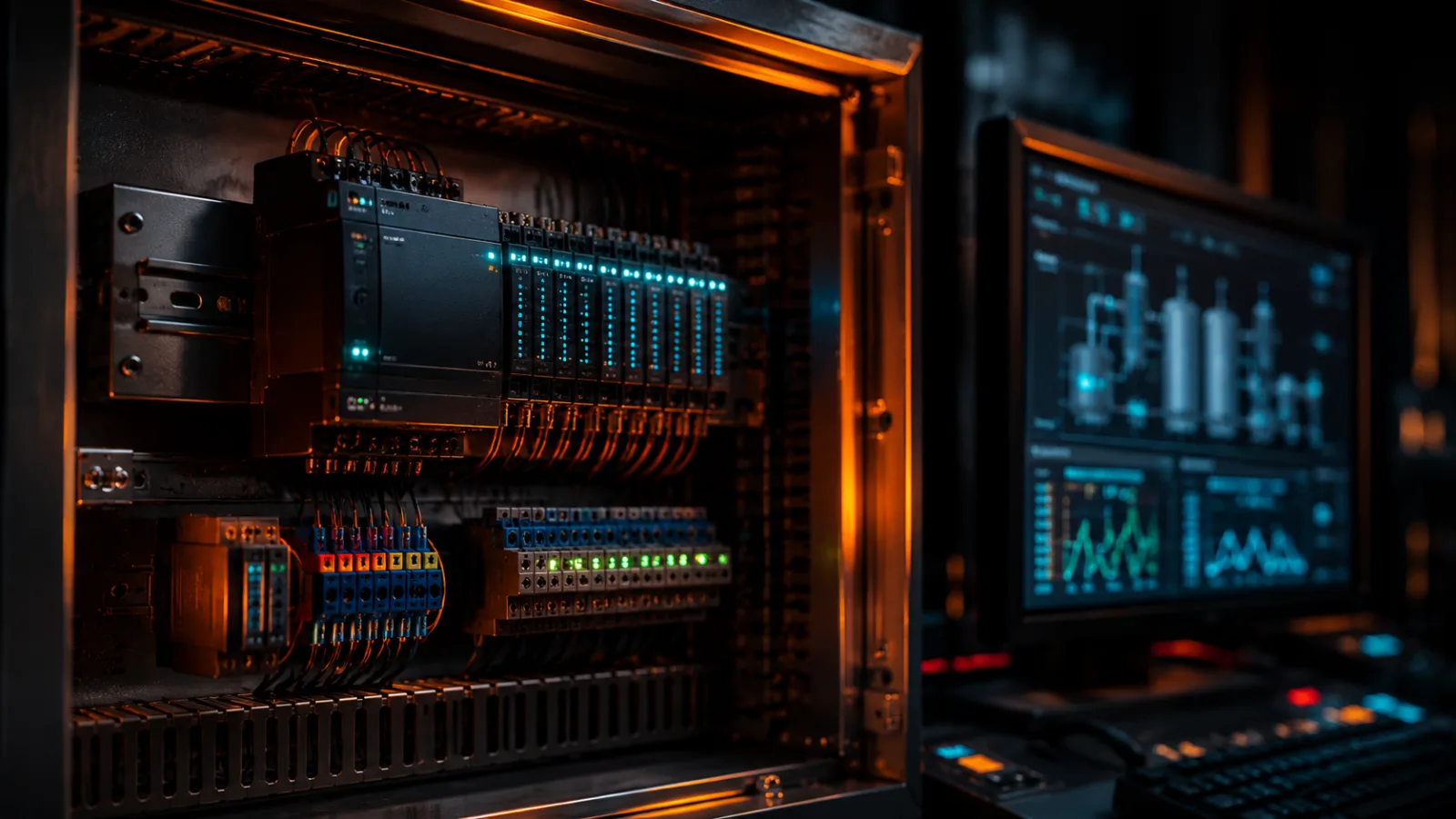
PLC and SCADA are two of the most important technologies used in modern industrial automation. From manufacturing plants and conveyor systems to water treatment facilities and process industries, these technologies help industries monitor machines, control processes, improve efficiency, and reduce human error.
For engineering and diploma students, learning PLC and SCADA can be an excellent way to connect classroom concepts with real industrial applications.
But what exactly are PLC and SCADA? How do they work together? What is the difference between them? And what should a beginner learn first?
This guide explains PLC and SCADA from the basics, with practical industrial examples.
What Is PLC?
PLC stands for Programmable Logic Controller.
A PLC is a specialized industrial computer designed to control machines and automated processes.
Unlike a regular computer, a PLC is built to operate reliably in industrial environments where there may be electrical noise, vibration, temperature changes, and continuous operation.
A PLC receives information from sensors and input devices, processes that information according to a programmed logic, and then sends commands to output devices such as motors, valves, relays, and actuators.
A simple example
Imagine an automated conveyor system.
A sensor detects that a product has reached a particular position.
The PLC receives the sensor signal and checks its programmed logic.
If the required conditions are satisfied, the PLC can:
- Stop the conveyor
- Start a motor
- Activate a pneumatic cylinder
- Turn on an indicator
- Count the product
- Send the machine status to an operator interface
This entire process can happen automatically within a very short time.
How Does a PLC Work?
A PLC generally works through a continuous cycle called the scan cycle.
The basic process is:
Inputs → Program Logic → Outputs
1. Inputs
The PLC receives signals from field devices such as:
- Proximity sensors
- Photoelectric sensors
- Push buttons
- Limit switches
- Temperature sensors
- Pressure sensors
- Level sensors
- Encoders
These signals tell the PLC what is happening in the physical system.
2. Program Logic
The PLC processes the input information according to the program written by the automation engineer or programmer.
For example:
If the start button is pressed and the safety condition is satisfied, start the conveyor motor.
3. Outputs
The PLC then controls output devices such as:
- Motors
- Contactors
- Solenoid valves
- Relays
- Lamps
- Buzzers
- Actuators
The PLC continuously repeats this process while the machine is operating.
What Is SCADA?
SCADA stands for Supervisory Control and Data Acquisition.
SCADA is a system used to monitor, collect, visualize, and supervise industrial processes.
While a PLC is primarily responsible for controlling a machine or process, SCADA provides a higher-level interface through which operators and engineers can observe what is happening across the system.
A SCADA system can display information such as:
- Machine status
- Temperature
- Pressure
- Flow rate
- Production count
- Motor status
- Alarm conditions
- Equipment faults
- Historical trends
Instead of looking at individual electrical panels or machines, an operator can monitor important process information from a computer screen.
A Simple Example of SCADA
Consider a factory with several production machines.
Each machine may have its own PLC.
The PLCs control the machines locally.
SCADA can collect information from those PLCs and display it on a central computer.
An operator might see:
Machine 1 — Running
Machine 2 — Stopped
Machine 3 — Fault
Production Count — 1,250
Temperature — 72°C
Pressure — 5.2 bar
If a machine develops a problem, SCADA can generate an alarm so that the operator knows that attention is required.
PLC and SCADA: How Do They Work Together?
PLC and SCADA are often used together because they perform different but complementary functions.
A simplified industrial automation architecture looks like this:
Sensors & Field Devices
↓
PLC
↓
Industrial Network
↓
SCADA System
↓
Operator / Engineer
The PLC interacts directly with the physical process.
SCADA provides monitoring, visualization, alarms, data collection, and supervisory control.
Example: Automated Water Tank System
Imagine an industrial water tank.
A level sensor measures the water level.
The PLC receives the sensor signal.
If the water level becomes too low, the PLC can start a pump.
When the tank reaches the required level, the PLC can stop the pump.
SCADA can then display:
- Current water level
- Pump ON/OFF status
- Tank status
- Alarm conditions
- Historical level trends
The operator can monitor the entire process from the SCADA screen.
PLC vs SCADA: What Is the Difference?
One of the most common questions beginners ask is:
“Is PLC the same as SCADA?”
No.
They have different roles.
| PLC | SCADA |
| ------------------------------------- | ------------------------------------------------ |
| Programmable Logic Controller | Supervisory Control and Data Acquisition |
| Controls machines and processes | Monitors and supervises processes |
| Works directly with field devices | Collects and displays process information |
| Executes control logic | Provides visualization and supervisory functions |
| Usually operates close to the machine | Usually operates at a higher supervisory level |
| Uses inputs and outputs | Uses data from PLCs and other industrial devices |
A simple way to remember it is:
PLC controls the process. SCADA helps humans see and supervise the process.
In a real industrial system, they often work together rather than replacing one another.
What Is HMI and Where Does It Fit?
If you are learning PLC and SCADA, you will also come across another important term:
HMI — Human Machine Interface.
An HMI is a user interface that allows an operator to interact with a machine or process.
For example, an HMI touchscreen may allow an operator to:
- Start or stop a machine
- View motor status
- Change a setpoint
- View alarms
- Check sensor values
- Monitor production information
HMI is generally used closer to the machine, while SCADA can provide broader monitoring and supervisory capabilities across larger systems.
A simplified structure could be:
Sensors → PLC → HMI
and for larger systems:
Sensors → PLC → Industrial Network → SCADA
Depending on the system architecture, PLCs, HMIs, SCADA systems, drives, controllers, and other devices may communicate over industrial networks.
What Are the Main Components of a PLC System?
A typical PLC-based automation system can contain several important components.
1. CPU
The CPU is the main processing unit of the PLC.
It executes the control program and processes information received from the inputs.
2. Input Modules
Input modules receive signals from field devices.
Examples include:
- Push buttons
- Proximity sensors
- Limit switches
- Temperature transmitters
- Pressure transmitters
3. Output Modules
Output modules send signals to devices that need to be controlled.
Examples include:
- Motors
- Relays
- Contactors
- Solenoid valves
- Indicator lamps
4. Power Supply
The PLC system requires an appropriate power supply to operate its electronic components.
5. Communication Interfaces
Modern PLCs can communicate with other automation devices through industrial communication networks.
This allows PLCs to exchange information with:
- HMIs
- SCADA systems
- Variable Frequency Drives
- Remote I/O
- Other PLCs
- Industrial computers
What Programming Languages Are Used in PLCs?
PLC programming can be performed using different programming languages defined by the IEC 61131-3 standard.
Some commonly encountered languages include:
Ladder Diagram (LD)
Ladder Logic is one of the most widely used PLC programming methods, especially for beginners and engineers with an electrical-control background.
It visually resembles traditional relay control circuits.
Function Block Diagram (FBD)
FBD represents control logic using interconnected functional blocks.
Structured Text (ST)
Structured Text is a text-based programming language useful for more complex logic and calculations.
Sequential Function Chart (SFC)
SFC can be used to represent sequential operations and machine states.
For beginners, Ladder Logic is often a good starting point because it provides an intuitive connection between electrical control concepts and software-based control logic.
Where Are PLCs Used?
PLCs are used across a wide range of industries.
Manufacturing
PLCs can control:
- Conveyor systems
- Assembly lines
- Packaging machines
- Sorting systems
- Material handling systems
Automotive
Automation systems can use PLCs for:
- Assembly
- Inspection
- Robotic processes
- Material handling
- Production-line control
Water and Wastewater
PLCs can control:
- Pumps
- Valves
- Tank levels
- Treatment processes
Food and Beverage
PLCs can be used for:
- Processing
- Filling
- Packaging
- Conveyor systems
- Temperature control
Power and Utilities
Automation and control systems can use PLCs for monitoring and controlling equipment and processes.
Process Industries
PLCs and related automation systems can be found in industries such as:
- Chemical
- Pharmaceutical
- Cement
- Oil and gas
- Manufacturing
The exact architecture depends on the application, plant size, safety requirements, and control strategy.
Where Is SCADA Used?
SCADA systems are commonly used when operators need to monitor and supervise complex or distributed processes.
Examples include:
- Manufacturing plants
- Water treatment facilities
- Power systems
- Oil and gas facilities
- Building and infrastructure systems
- Process industries
- Large industrial automation systems
SCADA becomes particularly useful when there are many machines, sensors, processes, or locations that need to be monitored from a central interface.
Why Should Engineering and Diploma Students Learn PLC and SCADA?
Engineering education provides important theoretical knowledge.
However, industrial automation requires the ability to connect that knowledge with real machines and processes.
Learning PLC and SCADA can help students understand how concepts such as:
- Electrical control
- Sensors
- Motors
- Digital logic
- Instrumentation
- Industrial communication
- Programming
- Automation
come together in a real industrial environment.
For diploma students and engineering students from fields such as electrical, electronics, instrumentation, mechanical, mechatronics, and related disciplines, PLC and SCADA can be particularly relevant.
PLC and SCADA Skills Can Support an Industrial Automation Career
PLC and SCADA knowledge can be useful for people interested in roles such as:
- PLC Programmer
- Automation Engineer
- Control Engineer
- Commissioning Engineer
- SCADA Engineer
- Industrial Automation Engineer
- Maintenance Engineer
- Electrical Automation Engineer
However, learning software alone is not enough.
A strong automation professional should understand the relationship between software, electrical systems, instrumentation, machines, and industrial processes.
That is why practical learning is important.
What Should a Beginner Learn First?
If you are completely new to industrial automation, jumping directly into advanced SCADA systems can be confusing.
A better learning sequence is:
Step 1: Understand Basic Electrical Concepts
Learn the fundamentals of:
- Voltage
- Current
- Relays
- Contactors
- Motors
- Sensors
- Switches
- Control circuits
Step 2: Learn PLC Fundamentals
Understand:
- PLC architecture
- Inputs and outputs
- Digital and analog signals
- PLC scan cycle
- Memory
- Timers
- Counters
- Basic logic
Step 3: Learn Ladder Logic
Start with simple programs such as:
- Start/Stop control
- Motor control
- Timer operations
- Counter operations
- Interlocking
- Sequential control
Step 4: Learn HMI
Understand how an HMI communicates with a PLC and how operators interact with machines.
Step 5: Learn SCADA
Move into:
- Tags
- Graphics
- Alarms
- Trends
- Data logging
- User interfaces
- PLC-SCADA communication
Step 6: Learn Industrial Communication
Depending on your target industry, explore industrial communication technologies and protocols.
Step 7: Build Practical Projects
This is where theoretical knowledge becomes practical skill.
Beginner-Friendly PLC and SCADA Project Ideas
Students can start with relatively simple projects and gradually increase complexity.
Project 1: Automatic Water Tank Control
Use a level sensor and PLC logic to automatically control a pump.
Project 2: Conveyor Belt Automation
Create a system where sensors detect products and the PLC controls conveyor movement.
Project 3: Traffic Light Control
Program a PLC to control traffic lights using timers and sequential logic.
Project 4: Motor Start/Stop Control
Build a basic motor control system with start, stop, interlocking, and fault conditions.
Project 5: Automated Sorting System
Use sensors and actuators to identify and route objects.
Project 6: SCADA-Based Tank Monitoring
Connect a PLC-controlled tank system to SCADA and display:
- Tank level
- Pump status
- Alarms
- Trends
Projects like these help students understand how sensors, PLC programming, control systems, HMI, SCADA, and industrial hardware work together.
Common Mistakes Beginners Make
Learning industrial automation can be much easier if you avoid a few common mistakes.
1. Learning Only Software
Knowing how to write Ladder Logic without understanding the physical machine can limit your ability to troubleshoot real systems.
Learn both control logic and industrial hardware.
2. Memorizing Programs
Don't simply copy PLC programs.
Understand why each instruction is being used.
3. Ignoring Electrical Fundamentals
PLC programming is closely connected with electrical control systems.
A basic understanding of relays, contactors, sensors, motors, and control circuits is extremely valuable.
4. Avoiding Practical Projects
Watching tutorials is useful, but industrial automation is a practical field.
Try to build and troubleshoot projects.
5. Trying to Learn Everything at Once
You don't need to learn every PLC brand, communication protocol, and SCADA platform immediately.
Start with fundamentals and build progressively.
PLC and SCADA Learning: Theory vs Practical Training
There is a major difference between knowing what a PLC is and being able to troubleshoot a PLC-controlled machine.
For example, a beginner may understand that:
Sensor → PLC → Motor
is the basic control relationship.
But in a real system, you may need to determine:
- Why isn't the sensor detecting the object?
- Is the input reaching the PLC?
- Is the PLC logic correct?
- Is an interlock active?
- Is the output switching?
- Is the contactor working?
- Is the motor receiving power?
- Is there a fault condition?
- Is the communication with the HMI or SCADA system working?
This is why hands-on industrial training is valuable.
Practical training allows students to work with real or simulated industrial scenarios instead of learning only from theory.
PLC and SCADA in the Future of Industrial Automation
Industrial automation continues to evolve.
Modern factories increasingly combine traditional PLC-based control with technologies such as:
- Industrial networking
- Robotics
- Machine vision
- Data acquisition
- Artificial intelligence
- IIoT
- Cloud platforms
- Predictive maintenance
- Digital monitoring
This does not make PLC and SCADA obsolete.
Instead, these technologies increasingly become part of larger connected automation systems.
For students planning a career in industrial technology, understanding the fundamentals of PLC, HMI, SCADA, sensors, control systems, and industrial communication provides a strong foundation for learning more advanced technologies.
Frequently Asked Questions
Is PLC difficult to learn for beginners?
PLC programming can seem complicated initially, but beginners can learn it progressively. Starting with electrical fundamentals, basic PLC concepts, and simple Ladder Logic programs makes the learning process easier.
Can diploma students learn PLC and SCADA?
Yes. Diploma students from relevant technical disciplines can learn PLC and SCADA. A basic understanding of electrical, electronics, instrumentation, or industrial systems can be helpful.
Do I need programming knowledge to learn PLC?
You do not necessarily need advanced programming knowledge to begin learning PLCs. Basic logical thinking is more important at the beginning. As you progress, programming concepts become increasingly useful.
Is PLC the same as SCADA?
No. A PLC primarily performs control operations, while SCADA provides supervisory monitoring, visualization, alarms, and data acquisition. They are frequently used together.
Which should I learn first: PLC or SCADA?
For beginners, it is generally better to learn PLC fundamentals first, followed by HMI and then SCADA. Understanding the control system makes SCADA concepts easier to understand.
Can PLC and SCADA help with career development?
Yes. PLC and SCADA are relevant skills for several industrial automation and control-related roles. However, career growth also depends on practical experience, troubleshooting ability, electrical knowledge, industrial communication, and understanding of real-world processes.
Can I learn PLC and SCADA without an engineering degree?
Yes. Diploma students, technicians, and learners from technical backgrounds can learn PLC and SCADA. Practical skills and understanding of industrial systems are important.
Final Thoughts
PLC and SCADA are fundamental technologies in industrial automation.
A PLC interacts with machines and executes control logic, while SCADA allows operators and engineers to monitor and supervise industrial processes.
For engineering and diploma students, learning these technologies can provide an important bridge between technical education and real industrial applications.
The best approach is not to learn PLC and SCADA as isolated software tools.
Instead, understand the complete system:
Sensors → Electrical Control → PLC → HMI/SCADA → Industrial Process
Then practice what you learn through real projects, troubleshooting exercises, and hands-on training.
If you are planning to build a career in industrial automation, start with the fundamentals, build practical projects, and gradually move toward advanced automation technologies.
Learn Industrial Automation Through Practical Training
At NEXISTEK, our approach focuses on connecting technical concepts with practical industrial applications.
Our training areas include PLC, HMI & SCADA, electrical and electronics, robotics, AI, microcontrollers, PCB design, industrial safety, and other technology-focused skills.
Whether you are a student, diploma holder, graduate, working professional, educational institution, or industry, practical technical training can help you develop skills that go beyond classroom theory.
FAQ
Q 1- What is PLC and SCADA?
A PLC is a programmable industrial controller used to control machines and processes, while SCADA is a supervisory system used to monitor, visualize, and collect data from industrial processes.
Q 2- Is PLC the same as SCADA?
No. PLCs primarily execute control logic and interact with field devices, while SCADA systems provide supervisory monitoring, visualization, alarms, and data acquisition.
Q 3- Which should I learn first, PLC or SCADA?
Beginners should generally learn PLC fundamentals first, followed by HMI and SCADA. Understanding how PLCs control machines makes SCADA concepts easier to understand.
Q 4- Can diploma students learn PLC and SCADA?
Yes. Diploma students from electrical, electronics, instrumentation, mechanical, mechatronics, and related technical fields can learn PLC and SCADA.
Q 5- Do I need programming knowledge to learn PLC?
Advanced programming knowledge is not required to begin learning PLCs. Beginners can start with basic logic and Ladder Diagram programming and gradually develop more advanced programming skills.
Q 6- Can PLC and SCADA help with an industrial automation career?
Yes. PLC and SCADA skills are relevant to roles such as PLC programmer, automation engineer, control engineer, commissioning engineer, SCADA engineer, and maintenance engineer.
Build skills. Work on real problems. Prepare for industry.
NEXISTEK — Industry-Focused Technical Training & Professional Skill Development